You are missing a tooth, tired of working around the gap, and someone mentioned implants. Then came the doubt. Is my bone good enough? Am I too old? Will my diabetes rule me out? Those questions stop a lot of people before they ever ask a dentist.
Most healthy adults with a missing tooth are candidates for dental implants. The real question is not whether you qualify today. It is whether your jawbone, gums, and general health are ready, or can be made ready. Many people who assume they are ruled out turn out to be fine after a little prep.
Dr. Anthony D. Maslo, DMD, is an Accredited Member of the American Academy of Implant Dentistry. He has placed implants in west Pittsburgh for more than 30 years. That training matters here. Implant candidacy is a clinical judgment about your specific bone and health, not a checklist you pass or fail online.
Key Takeaways Before Your Implant Consult
- Most healthy adults missing one or more teeth are candidates for dental implants.
- Enough jawbone is the single biggest physical requirement, and grafting can rebuild it when it falls short.
- Well-controlled diabetes and past smoking usually do not disqualify you, though both need managing first.
- There is no upper age limit for implants, only a lower one, once jaw growth finishes in the late teens.
- A 3D scan and exam are the only reliable way to know, so book an evaluation rather than guessing.
What Makes Someone a Good Candidate?
A good candidate has one or more missing teeth, enough healthy jawbone to anchor the implant, gums free of active disease, and general health steady enough to heal. Think of it in two buckets: structural, meaning your bone and gums, and systemic, meaning your body overall. Both need to be in decent shape, or brought there, for an implant to last.
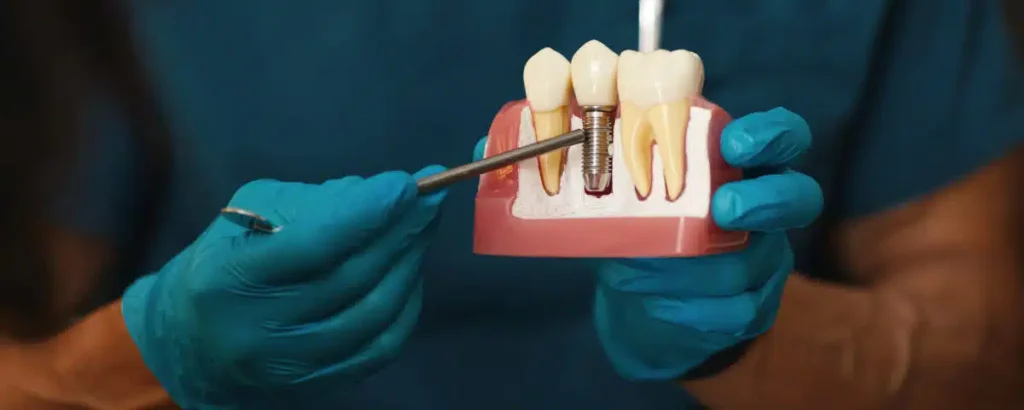
A dental implant is a small titanium post placed in the jaw. Over a few months, it fuses with the bone. That fusion, called osseointegration, lets the implant hold a crown as firmly as a natural root. Everything on the candidacy list exists to protect that fusion.
The encouraging part is how few people are permanently ruled out. Most gaps between “not a candidate” and “good candidate” close with treatable steps, not a hard no.
Do I Have Enough Jawbone for an Implant?
Enough bone is the foundation of every implant, because the post needs solid bone to fuse with and hold a bite force. When a tooth is lost, the bone beneath it starts to shrink within months. If you have waited years, some loss is likely, but that alone rarely ends the conversation. Grafting can rebuild what is missing.
Bone loss speeds up right after a tooth goes. Research in Clinical Implant Dentistry and Related Research found the jaw can lose up to 25 percent of its width in the first year after an extraction. That is the honest reason not to sit on a gap for a decade.
When bone is thin, a few routine options rebuild it. A socket graft placed at extraction preserves the ridge. A sinus lift adds height in the upper back jaw. These add months to the timeline, not a permanent barrier.
Does Diabetes or Smoking Rule Me Out?
Neither one is an automatic no, but both change the plan. Well-controlled diabetes heals close to normal. A systematic review in the Journal of the American Dental Association looked at this. Patients with an HbA1c under 8 percent reached implant survival rates similar to people without diabetes. Uncontrolled blood sugar is the real risk, not the diagnosis itself.
Smoking is the bigger lever you control. Tobacco narrows blood flow to the gums and slows healing. Studies put implant failure in smokers at roughly two to three times the rate seen in non-smokers. Quitting, even for the weeks around surgery, meaningfully improves the odds.
Your dentist will ask about both at the exam, along with any medications. Blood thinners, bone drugs called bisphosphonates, and immune-suppressing medicines all deserve a mention, because they shape timing and planning rather than block treatment outright.
Am I Too Old for Dental Implants?
There is no maximum age for dental implants. Healthy adults in their 70s, 80s, and beyond get implants and do well. Eligibility rests on bone quality, gum health, and healing capacity, not the number on your license. Age matters far more at the young end of the range.
Implants are held off until the jaw finishes growing, usually the late teens. Placing one in a still-growing jaw can leave it out of position later, so a younger patient gets a temporary tooth to hold the space until growth completes.
For older adults, the exam simply pays closer attention to medications and health conditions. A steady, well-managed 80-year-old is often a better candidate than a 40-year-old with untreated gum disease.
Conditions That May Delay or Complicate Treatment
Some situations call for extra planning or a pause before implant surgery, not a flat refusal. Active gum disease has to be treated first, since infection undermines healing around a new implant. A few situations are most likely to delay treatment: severe uncontrolled illness, ongoing head or neck radiation, and a heavily suppressed immune system.
Active gum disease is the most common fixable roadblock. Treat the infection and get the gums healthy before any implant goes in. Skipping that step is the fastest route to a failed implant.
A short list of factors deserves a frank talk at your consult, because each shifts the plan:
- A history of head or neck radiation, which affects bone healing
- Bisphosphonates or other bone-density drugs
- Autoimmune or bleeding disorders
- Chemotherapy that is active or recent
None of these is an automatic disqualification. Each is a reason for your dentist to plan carefully and, when useful, coordinate with your physician.
What Happens at a Dental Implant Evaluation?
A proper evaluation reviews your health history, examines your mouth, and takes a 3D scan to measure bone before anyone commits to surgery. The scan, called a cone beam CT, shows bone height, width, and the exact spot of nerves and sinuses. A flat dental X-ray cannot show that. The 3D image is the honest basis for a yes or no.
The visit also covers your goals and the realistic timeline. Straightforward cases with good bone can finish in three to six months. Cases that need grafting or gum treatment first run closer to a year, since bone needs real healing time.
This is your chance to ask about cost, insurance, and each step before deciding anything. A good consult ends with a clear plan, not pressure.
Getting Evaluated for Implants in Pittsburgh
If a missing tooth has you wondering where you stand, the fastest way to a real answer is an exam and a 3D scan, not another late night reading candidacy checklists. our dental clinic in Pittsburgh, led by Dr. Anthony D. Maslo, DMD, evaluates and places dental implants at 2200 Noblestown Road, Suite 100, serving patients across west Pittsburgh, Carnegie, Crafton, and the surrounding area.
Dr. Maslo is an AAID Accredited Member who trained through the New York Maxicourse in implant dentistry. Your bone and health get assessed by the same person who plans the treatment. If a graft or a wait makes sense for your case, he will tell you plainly and map the steps.
To find out whether you are a candidate for dental implants, call Gentle Family Dentistry Pittsburgh at (412) 922-5050 to book an evaluation. One honest exam beats months of wondering.